Sunday, May 31, 2015

4 Things You Need Besides Water


When you bike, you sweat.
When you sweat you need to drink water.
When you drink just water, you need to give your body electrolytes as well.
"But Why?" You may ask.

Electrolytes are the gate keepers of support materials for a rider's muscles. 
When you push your muscles you are using up electrolytes in the process. When one releases liquid from their body, in any form, it is primarily excess water and electrolytes. So you've got to replenish them!

I'm going to try to briefly go into how electrolytes are made but please understand, I am no Bill Nye.There are four things used to make up electrolytes, Sodium, (Na) Potassium, (K), Magnesium (Mg), and Calcium (Ca). When any of these elements get diluted in water their ions become charged. All of our cells use that charge as a driving force. 

My version: No electrolytes, muscles no move good. 

If you go to the grocery store and ask "where is your potassium?" I doubt you will get the answer you are looking for. So to help you out we've created a chart of a few of our favorite hydration mixes and their levels of the 4 elements that contribute to electrolytes. Everybody's body is different so you might want to experiment with varying amounts of the elements. Find the levels that work for you and have a great ride!


BRAND          Serving               Sodium              Potassium           Magnesium           Calcium

EFS                      32g                   300mg                 160mg                   150mg                 100mg
Skratch                 12g                   180mg                   20mg                    6%                        2%
Perpetuem            69g                   210mg                   80mg                       8mg                   35mg


These are not the end all be all hydration mixes, just some of our favorites around the shop. Each brand and type have their focus and niche. I suggest doing a little research on a few you may be interested in. This is a great strategy in trying out different nutrition. My favorite is Skratch, so to talk a little bit more on the topic of hydrating is Aaron from Skratch Labs


Keep in mind that your body only keeps stock of what it needs. The best system for hydration does not start during the weekend ride, but the start of the week. The body does not know your future plans and activites so it is only set up for what you are doing currently. This means you should prepare the body to hold more fuel through the week so it is prepared to stock up during your active moments. A combination of exercise and electrolyte consumption days before high levels of activity is best.  

Friday, May 29, 2015

Medically Based Bike Fitting


Why should anyone get fit?

Fit is for everybody, not just the racers. Riding a bike should be fun and pain free, if you only ride a certain distance or you have saddle discomfort or any other discomfort you would benefit from a bike fit.

So you practice fit at Orange Cycle, where they use the Body Geometry Fit method. What is a Body Geometry Fit?

Body Geometry Bike Fit is a medically based process, we spend the first hour of your fit learning about your biking and injury history and  assessing your goals, then we perform a 22 point inspection of your body to get detailed information of your personal flexibility, skeletal angles and any limitations. With this information we do not have to use averages.  Everyone is slightly different.  Using your specific information will always be the most detailed and accurate process. After the pre fit assessment, we move through a 15 step process using your body information to fit your bike to you.

What kind of training have you had?

I have been through all 3 levels of Specialized Bicycles Components University. Each is a hands-on, week-long class in Morgan Hill, California. After completing the 3 levels of education, I was then qualified for the 2-day Certification testing. The testing is designed to be incredibly taxing and a true test of knowledge and practice. I am one of only two Certified Body Geometry Fit Technicians in the state of Florida, and less than 100 nationally. 

All the educational material is a collaboration between Specialized and the Boulder Center for Sports Medicine. Each of my classroom experiences were led by Andy Pruitt, PA-C, EdD from the Boulder Center for Sports Medicine. Andy Pruitt, PA-C, EdD and Aaron Post were the Proctors for my Certification Testing.


What sets the body geometry fit apart from other experiences?

Because of the medical background of Body Geometry Fit we have more information to work with, we are sometimes making adjustments in 1 or 2 millimeters to get to a pain free position, whereas other computer based systems base their adjustments on averages of maybe 5000 athletes.

The Orange Cycle Fit Studio feels more like a doctor's office than
a part of a bike shop
A good example of this is if you had identical twins same height and weight but one had tight hamstrings limiting forward flexion, they would be unable to ride the same height on their handlebars but a system based on averages would have them in the same position. We are all individuals and our bike fits should be also. 

Can a Body Geometry Fit make a rider faster?

Yes. We make all the adjustments on the bike based on your pre fit assessment. We are looking to place you in a comfortable, neutral position but, most times the benefit is being stronger on your bike.

What is the role of technology in the fit studio?


People fit people not computers, you cannot tell a computer the position it has created for you is uncomfortable. 
We must use technology as a tool paired with the use of our knowledge and experience. 

Anyone using a computer-based system can position the rider using the numbers on the monitor, but the rider can still feel uncomfortable. Biomechanics and knowledge of human kinesiology are essential. For example, if you don't know that the person your working with has one leg longer than the other, or a hip impingement,  or a hip rotation, we cannot help with any discomfort they are feeling on the bike due to the lack of knowledge about the causes. 

I Heard you recently got another accolade to improve your services...

I am always looking for ways to improve my knowledge, so I recently became a certified personal trainer, this has helped improve my kinesiology and increase my depth of knowledge of the muscle skeletal system.


Monday, May 5, 2014

Confessions: Christine's Body Geometry Fit

I have discussed the importance of having your bicycle fit to your body. I have touched on what it means to be a fitter but there's one important perspective that has not been expressed: What is it like to go through a Body Geometry Fit?

Our newest employee, Christine, recently had her bike fitted to her and I asked her to say a few words about the process:

I have a confession. Years after purchasing my first bike-store quality bike, I still hadn't made the important investment in a proper fitting.

Some History


I'm a Bike enthusiast who enjoys a bike ride because it's the closest I can be to acting like a 10-year-old. I'm also a middle of the pack, age group, triathlete. I own many bells and whistles - fancy, carbon fiber frames, carbon Zipp wheels, power meter, Di2 Electronic shifting, all top of the line stuff, yet 

here I was, the start of my 7th year without a proper bike fit.

Recently, I realized I wasn't as comfortable riding. My bike was dictating how long my ride would be, instead of the other way around. It was time to take action.

I was skeptical about the true benefit of the fit process. Could a couple of centimeter adjustments here and there really make me more comfortable?

How It Went Down

The process itself is so simple and enjoyable I felt as though my bike and I spent some time together at a spa. Initially, I spoke to the fitter, I'll call him John Hollingsworth (because that's his name) about my riding style and what I wanted to accomplish. I explained that I wanted to go further and stay comfortable. He then conducted some range of motion assessments and took some relative measurements.
I quickly noticed that attention to detail is key to the Body Geometry fit process. Everything was taken into account, down to the length of my leg bones.


Some of the major factors that were addressed were my knee angle going from an under-utilized 22 degrees to a perfect 30 degree extension. My reach was shortened to increase control and weight distribution. Both adjustments made a serious impact on my level of comfort.  Shoes are also a part of the equation. My cleats have been adjusted and John recommended an impressive Body Geometry insole which adds some much needed arch support to straighten knee rotation. All the information is compiled and used to adjust the bike to me.

A bike is a wonderful invention, offering something for, quite literally, everyone. As a young child, it's a right of passage to learn to ride all by yourself. Later, we use bikes to get to friends or school. Bikes to commute, get exercise, challenge ourselves against ourselves, or even against our friends. Young and old, fit and those who aim to be, commuters and enthusiasts all have a bike. If you've made the investment in a great bike, you also deserve the bike to fit you the way it was intended.


As if the fit process weren't enough, the very best part is the result!I feel so in tune with my bike, it's like a whole new experience. Better yet, a new bike which was made just for me. I'm pushing the mileage and remaining comfortable. You truly don't know how much fun you are missing by riding a bike and not having it fitted properly to your body.

Wednesday, January 22, 2014

Battle Royal: Mio VS Polar RC3

Technology has never been so prevalent in this sport we love. At one point everyone would ride bikes to get away from numbers and expectations. Then everyone needed to know how fast they are going, then how far they have gone. Now it didn't count unless the GPS map of your ride with heart rate, climb and slope was shared on STRAVA.

With all these additional bells and whistles available, heart rate is something we at the shop take very seriously. If your speed is off, your map doesn't quite nail down the mileage or your watts are slightly inaccurate, it's easy to calibrate or compensate to correct. One's heart rate is a constant. There is no inaccurate heart rate, only inaccurate readings.  Not to mention it is often a matter of staying healthy or pushing one's body too hard. Needless to say, it needs to be dead on.

The Contenders 
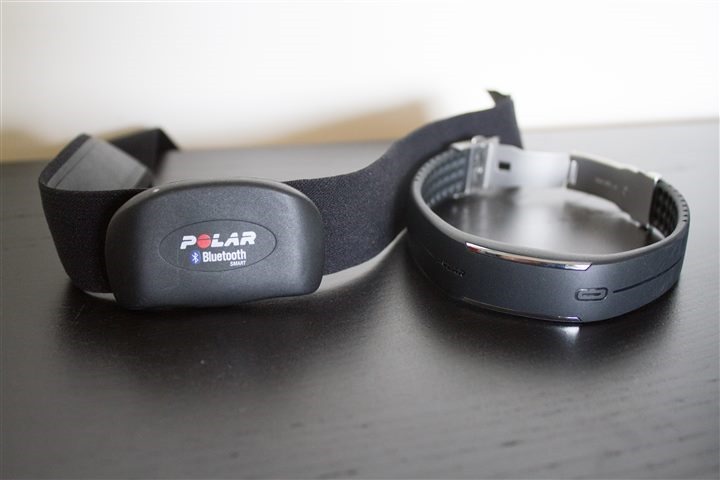
Polar RC3 and sensor

Polar has been a long time standard of the store due to its medical grade heart rate. Instead of relying on algorithms from every third recorded thump, Polar records every up, down and valley in between of one's heart rate.

Mio Alpha Sport Watch
Mio is the new kid on the block. It is one of the first to implement an infrared sensor to read heart rate through the wrist. This is a big deal because before this, if an athlete wanted to check their respective lubs and dubs they required a chest strap.

The only controversy of the strapless method that Mio promotes is that it has only been proven accurate at a resting heart rate. Due to the faster pace and sporadic nature of cardio, the more exertion the body is put under, the more inaccurate it becomes.  

The Show Down

We wanted to check for ourselves. So we sent Neal to do his normal work out with a Polar RC3 featuring medical-grade heart rate and a Mio Alpha to see how close they were. The idea being that the Polar is completely correct, and how well does the Mio hold up? The results were impressive.


Clearly the Mio didn't quite match up to Neal's needs. Over 50 bpm off of medical grade readings. If you need to monitor your heart rate while watching a movie or reading I'm sure the Mio will be more than adequate. However, most people interested in heart rate need to know it during physical exertion which just happens to be the weakest point for Mio. If you want to listen to your body, get a product that can really listen. 

Friday, December 6, 2013

Review: Polar Loop, For the 'Rest' of the time

Cheetahs and greyhounds are built very similarly. Both are built for very high speeds. Both also have very long rest times throughout the day. Due to their high metabolism and low body fat that is crucial to their speed, the longevity of their speed is limited at best. Cheetahs have a max speed of 70-75 mph but a max distance of 1,600 feet. The greyhound has a max speed of 43 mph (second only to the cheetah) and a max distance of 820 feet.
Humans are not built like cheetahs or greyhounds, but many people take their riding with very similar procedures. While a rider may average 20-25 mph for 3 hours, they may also be sitting behind a desk for the rest of the day. This is not how our bodies effectively perform and that rider may be stunting his progress and performance.

I'm sure the initial response everyone is having is "I need to rest!" or "I cannot type while on a treadmill!"

Blue Cross Blue Shield states that the average adult should take 10,000 steps a day to ensure an active lifestyle. This can be achieved by parking farther away, using the restroom on a different floor of your office building, taking the stairs, there are many easy options.
The best tool to keep track of your daily activity is the Polar Loop. I know now-a-days everyone can find a pedometer from Big Lots. And there is a lot of high-end wrist-jewelry that will tell you your heart rate, sleep patterns and what you're about to think. Both these devices are not the best options and I'll tell you why.
Pedometers are based on gyroscopes. Missing key information like time of activity and skewing numbers with improper gyroscope readings from shifting weight while sitting. Walking is not measured from one's hip,
Polar Loop's website. You can't get this kind of
info from a pedometer.
it's measured through actual movement.
The abundance of all-day measurement devices on the market today shows that the technology to produce one is not hard to find. However it is hard to do correctly. infrared heart rate is designed to be used while the body is in a resting position only, and gets more inaccurate the more active the wearer is. It can be up to 30bpm off. When dealing with a number that is anywhere from 40-60 bpm to 170-190, 30 bpm is a pretty huge variable.
Also, there is no combination of technical data and algorithms that can effectively tell anyone about personal sleep patterns without including variables so large, they practically make the information void. If sleep studies could be done without the hundred wires stuck all over the patient's body and the node-covered skull cap, don't you think they would offer that option?

The Polar Loop is an activity monitor that does not promise anything except reliable and effective information. It is to take control of your day, in it's entirety. This makes sense for everyone. For the most active athlete, it is imperative to keep their body in effective shape, which means a healthy level of activity. For the not-so-athletic person, it is helpful to ensure they are being healthy without requiring a sport or too much additional effort. It is also the only method of measurement backed by Blue Cross Blue Shield to improve one's level of daily activity.

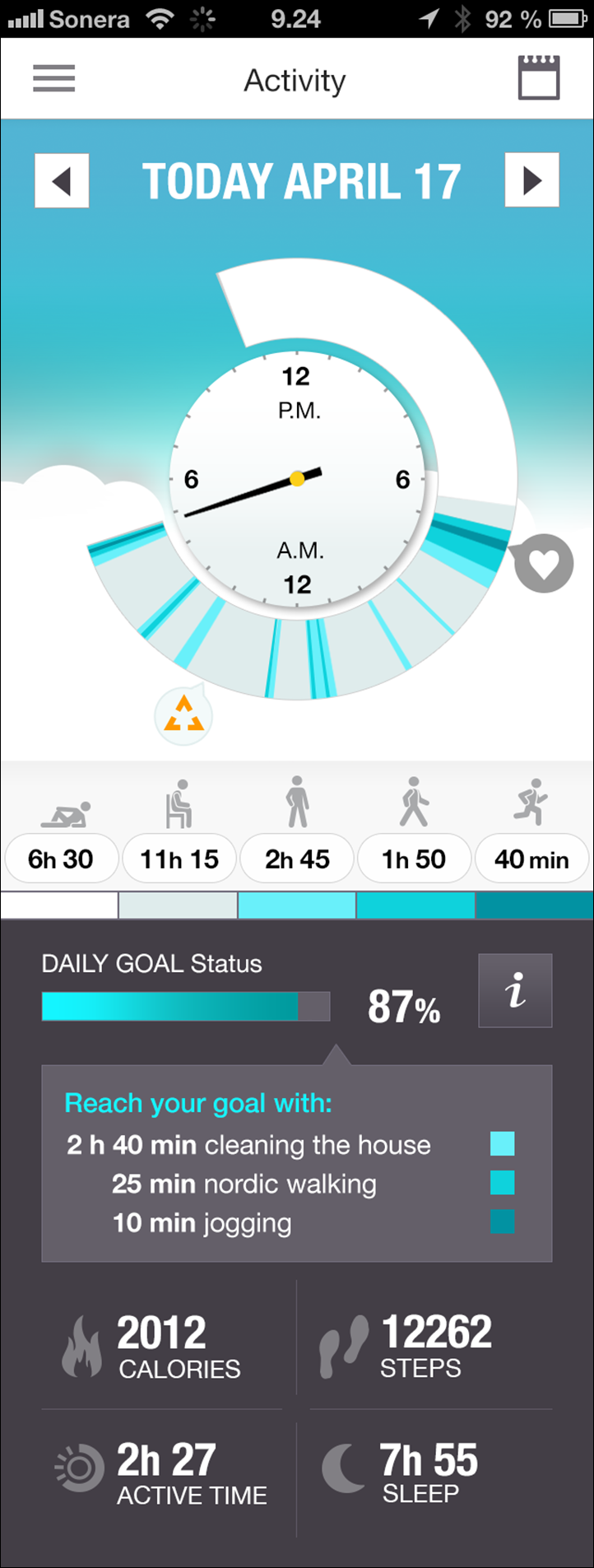
When you wear a Polar Loop it uses 3D accelerometers to measure 360 degrees of movement. It also uses a dual-coil system to measure actual movement of travel, not just the back and forth rotation of your arm. Basically, it can tell when you sit, stand, when you are walking, when you're jogging and when you're just standing in an elevator.
Level up by adding medical
grade heart rate.
By combining this information with your age, weight, and height it provides an average of calories you have burned, and how active you have been during that day. It also provides amounts of different activities the wearer can do to complete a healthy level of activity. If you want to really dial your numbers in, you can add a bluetooth equipped H7 heart rate strap to equip the Loop with medical-grade heart rate.

Due to it's simple design and display, it is water proof and holds a long battery life.
The Loop charges via USB and also downloads all of your information to the Polar Loop website. It gives you day-to-day productivity and an ever changing list of many different activities to improve your lifestyle such as badminton, jogging, even doing the dishes.
The app is not only
helpful, but colorful!
I preferred the app to log my progress. With a bluetooth connection, the app can let you know how active you've been on a 5 point scale, from resting to running, and when the activity took place. It also has the ability to remind you when you have been inactive for too long with phone-based alarms.
Working in retail, and biking as a life-consuming hobby, I considered myself to have a fairly healthy lifestyle. But it only took a couple of days wearing the Loop to find out that I was not as healthy throughout my day as I thought. It pushed me to change habits so I would be more active and, in turn, had a happier general outlook as well as a better sleep pattern.

It comes with a cut-to-fit locking strap to ensure a comfortable fit that is not cumbersome. There is even a easy measuring tool that comes with the Loop to guarantee the right fit.

While the person looking for extremely detailed information of their activity, usually provided by equipment like a Garmin 910 or Polar RCX5, may find the Loop a bit lacking, such competition is not Polar's goal. They set out to create an easy, automatic method of tracking and improving one's general activity throughout the day. I'd say that's exactly what they achieved.

Our price for a Polar Loop is $99.99 Not bad when you consider it's $40 - $700 for the few hours with a cycling specific computer. With a Loop you are taking control of the other 9 hours in the day!
For more information about the Polar Loop, Click Here! 


Monday, November 25, 2013

Certified, Level 2 and other Titles You Should Know when getting Fit

Thijs and Neal showing off their expertise
We are proud to announce that Thijs Schutte has passed his Body Geometry Certification Exam!
We are so proud and excited for his hard work and the continuation of our quality bike fit service. For as much as we are excited, many of you are indifferent and confused. Bicycle fit as an educated service is very new, starting around 2005. When people hear somebody is a doctor or surgeon, they understand the level of expertise that comes with said title. A "Master" or Certified fitter does not carry the same understanding. Because of this, many shops say offer a fit service, not only without any training but often times incorrect results. Many cyclists end up paying significant amounts of money and receive debilitating results. So I'm here to clear it up!

Tools of the trade
Body Geometry is the gold standard of bicycle fit. Focusing on a neutral body position based on the rider's flexibility, strength and style of riding. It was not only the first uniform fit system but also the only process focused on a rider's anatomy.

Educating the fit staff in what the rider's body is doing while on the bike is the focus of Body Geometry fit and the only way to know what directions to adjust the bicycle.

Here is a brief history and explanation of the Body Geometry Fit program from the creator, Dr. Andy Pruitt.


Within Body Geometry there are three levels. After completing the first Body Geometry Fit course, one is qualified as a fit technician. Once a substantial amount of fittings have been submitted back to SBCU (Specialized Bicycle Components University), to ensure the quality of service, the fit technician may then go for their Level II education, or his "Masters." This is a more in depth look at the anatomy, common medical complications and solutions.
Now a level II fit technician, after a similar amount of quality monitoring, they can take their certification test. There is no more education to gain at certification, only a rigorous practicum and written exam. The process is so challenging, only 100 fit technicians in the entire world have achieved this title. Only two fit techs in Florida are certified, John B. Hollingsworth and Thijs Schutte and they both work at our shop.


If you are having pains while riding your bike, want to prevent pain from rearing its head, or want to make sure every part of your body is working to go faster, schedule a fit with our knowledgeable and extremely well educated staff!
More  info on our Body Geometry Fit


Monday, November 4, 2013

A is for Aero

Despite the results, I feel the cape makes me faster.
Many cyclists look at the weight of their bike meticulously. Most are in denial of their 'weight weenie' status
but will pay hundreds more for grams of difference. Likewise, there is a large group of riders that could ace many medical tests due to their research and focus on their nutrition. However, when looking at the aerodynamics of a rider, there is a stigma of being a last resort, or "too expensive" to be worth the aid.
Everybody put on your helmets because you're mind is about to be blown:


Aerodynamics is the most effective advancement a rider can make.

Now for the nay-sayers who are yelling things like "Well it only helps above 20 mph!" or "The added weight makes the aero shapes ineffective!" Stop shouting at your computer, I can't hear you.
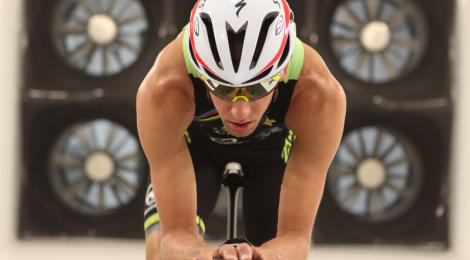
Myself and Neal were fortunate enough to do some work in Specialized's brand new wind tunnel in Morgan Hill, California. Approximately 4 hours of work, which worked out to roughly $9,000 of time and expertise in the facility.
We were there focusing on change of body position. To see if a more "aero" position was more important to the area of resistance than the loss of power from losing a neutral fit. Working with a caliber of engineers that routinely get called by NASA for help is humbling, to say the least. To say we learned a lot would be an understatement.

Here are a couple of things we learned: Aerodynamic drag is not relative to the rider's speed. While I'm sure many people feel the difference around 20 mph, wind resistance is impeding your performance the same at every speed. In fact, many of the engineers argued that because you are spending more time from A to B in the air-based resistance at lower speeds, it is actually effecting you more.
While aero equipment does end up being slightly heavier than non-winged products, weight resistance is constantly reduced by momentum, where air resistance is actually heightened by acceleration.  
The biggest take home was a staggering number of how much resistance was wind-based.
On average, 70% of a cyclist's resistance is from the air.
As much as 50% (35% of the whole) of that resistance could be from the rider themselves.

What does this tell us?
Aerodynamics is a huge part of what can make you go faster and keep you going faster.  Especially in a state where our hills come as gusts from either coast.

Best Bang for your Buck
With many companies realizing the importance of being "wind-minded," there is very good new on the horizon: equipment upgrades can be more effective for less money. When you hear aero a lot of people think of a full aero frame such as a Specialized Shiv, or carbon wheels like Zipp 404's and their hopes of cutting through wind are dashed by the price tags of these items. But if you're just looking for improvement in performace, you don't have to get the high ticket items.
The Evade, scientifically proven to be effective. 

Specialized Evade
The first upgrade recommended is an aero helmet.  The Specialized Evade has had more wind tunnel tested results than most bikes. Switching your helmet to a less turbulent model, like the Evade, actually helps a rider as much as a set of Zipp 404's. When compared to Zipp 404's price tag of $2700, the Evade's $250 price seems like a steal!


Pearl used the BMC pro team as
tests for their fabrics

Pearl Izumi P.R.O. Fabric
The cut of a rider's apparel, along with the fabric it is composed of is another big factor .Pearl Izumi P.R.O. Aero fabric is dimpled, much like a golf ball, to reduce drag by 8%. A huge advantage for a small
step up in price.


Neal's entire upper body became more aerodynamic after
his Body Geometry Fit
The Most Help You can get
Pertaining more to why we were there, the other major aero difference was made by having the bike correctly fit to the rider. When you are forcing your body to hold a position it isn't happy with, it is visible in the shape of the rider. It shows itself by bulging, contorting and compromising your naturally smooth position. It is of the utmost importance to be fit by somebody who is listening to your body and finding where it is the most aero, not by angles of the bike, but by anatomical construction and flexibility. This is the only way to find your personal level of aerodynamics and, subsequently, comfort.
To learn more about our fit program here at the shop, click here.

If you have any questions about these products, or want to know more about our Body Geometry Fit program please contact us or call the shop!